
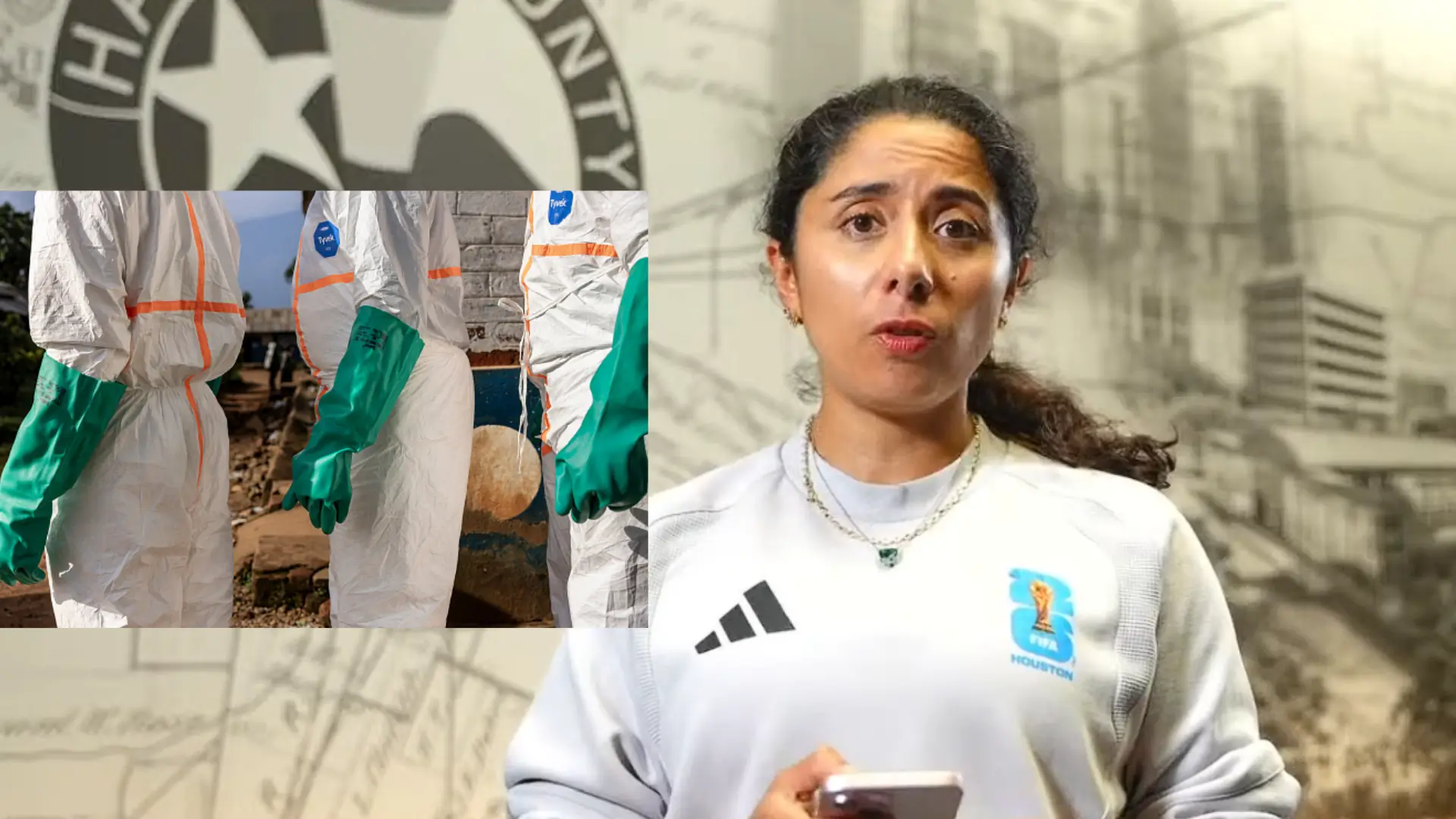
HOUSTON – With just weeks to go before Houston hosts its first FIFA World Cup match, Harris County Judge Lina Hidalgo addressed growing public concerns over Ebola cases connected to central Africa and what that could mean for the region during the international event.
During a livestream update posted Sunday night, Hidalgo emphasized that while the situation is being taken seriously, officials are not sounding the alarm.
Recommended Videos
“We are okay,” Hidalgo repeatedly reassured residents throughout the briefing. “Right now, it is a time to inform.”
Houston is scheduled to host seven FIFA World Cup matches at NRG Stadium beginning June 14, while also serving as a base camp location for the Democratic Republic of Congo national team.
The concern comes after the federal government announced that George Bush Intercontinental Airport will become one of only three U.S. airports designated to receive travelers arriving from Uganda, the Democratic Republic of Congo, and South Sudan amid an Ebola outbreak in the region.
According to Hidalgo, seven Harris County residents who had recently been in Uganda arrived in the Houston area over the last several days.
Two arrived Sunday, while five more arrived Monday.
She said all seven travelers were screened by federal authorities in Dallas and Washington, D.C., before continuing on to Houston.
“To be clear, none of them have tested positive for Ebola,” Hidalgo said. “In fact, none of them are showing any symptoms of illness.”
The World Health Organization has declared the current outbreak a public health emergency. Hidalgo said there are currently 10 confirmed Ebola cases in the Democratic Republic of Congo, with suspected cases estimated to be much higher.
How screening works at IAH
Hidalgo walked viewers through the current screening and monitoring process for travelers arriving from at-risk countries.
According to the county judge:
- Travelers are screened by the CDC upon arrival in the U.S.
- Officials conduct temperature checks and health questionnaires.
- Passenger information is shared with local health departments.
- Harris County epidemiologists are assigned to monitor local residents returning from those regions.
- Travelers are asked to take their temperature twice daily for 21 days.
- Health officials conduct daily check-ins and can perform home visits if necessary.
Hidalgo also noted that travelers showing symptoms or those with known exposure to Ebola patients could be isolated or quarantined.
She said two hospitals in the Houston area have already been designated for isolation treatment if needed.
“Nowhere near as transmissible as COVID”
A major point of Hidalgo’s message focused on calming fears about transmission during the World Cup.
“The likelihood of you or I getting Ebola from someone in airport security or by sitting next to somebody on the Metro on your way to the World Cup is extremely low,” she said.
Hidalgo stressed that Ebola spreads through direct contact with bodily fluids from someone who is severely ill — not through casual public interaction.
“This is not a virus that’s transmitted person-to-person unless you’re taking care of a very sick person with Ebola or even a corpse,” she explained.
She also referenced the 2014 Ebola case in Dallas, noting that despite a patient spending time at home with family members while symptomatic, only two ICU nurses later contracted the virus.