
HOUSTON – A Galena Park ISD middle school is starting the new school year with an A rating from the Texas Education Agency, as state leaders prepare to highlight the district’s performance in the newly released 2026 accountability ratings.
Woodland Acres Middle School earned an A with an overall score of 92 out of 100 in the 2026 A-F accountability system, according to TEA data reviewed Friday.
The campus also earned all seven distinction designations available to it, recognizing performance in several academic areas and measures.
Texas Education Commissioner Mike Morath is scheduled to visit Woodland Acres Middle School Friday afternoon as part of an event recognizing Galena Park ISD for what TEA described as its “A-F Accountability Success.”
The visit comes as the state releases its latest round of accountability ratings for Texas public schools and districts.
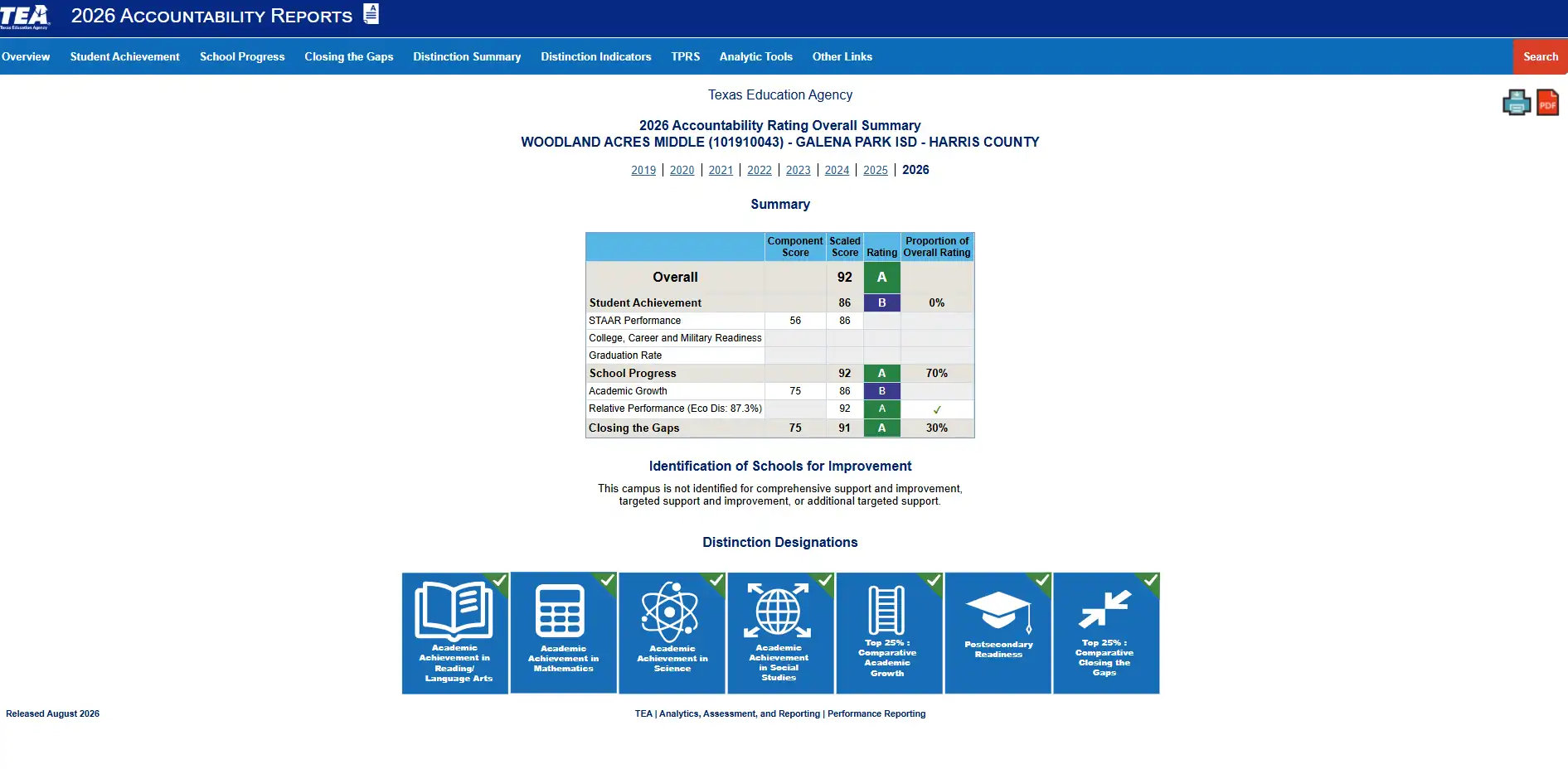
Woodland Acres Middle earns A, 92 overall
The 2026 TEA accountability report shows Woodland Acres Middle earned an overall score of 92, placing the campus in the A range.
The school received:
- Overall: 92 — A
- Student Achievement: 86 — B
- School Progress: 92 — A
- Academic Growth: 86 — B
- Relative Performance: 92 — A
- Closing the Gaps: 91 — A
The School Progress category accounted for 70% of the campus’ overall rating, while Closing the Gaps accounted for 30%.
Within School Progress, Woodland Acres received an A in Relative Performance, which measures a campus’ academic performance compared with schools serving similar percentages of economically disadvantaged students.
The TEA report shows 87.3% of students at Woodland Acres Middle are economically disadvantaged.
Campus earns all seven distinction designations
View data: TEA
Woodland Acres Middle also received seven distinction designations from TEA.
The campus was recognized for:
- Academic Achievement in Reading/Language Arts
- Academic Achievement in Mathematics
- Academic Achievement in Science
- Academic Achievement in Social Studies
- Top 25%: Comparative Academic Growth
- Postsecondary Readiness
- Top 25%: Comparative Closing the Gaps
Distinction designations recognize campuses that perform at a high level compared with similar schools across the state.
The TEA report also shows Woodland Acres Middle was not identified for comprehensive support and improvement, targeted support and improvement or additional targeted support.
Texas preparing to replace STAAR
During his visit, Texas Education Commissioner Mike Morath also discussed a major change coming to standardized testing in Texas.
The Legislature is replacing the STAAR test, with the current system expected to begin phasing out during the 2027-28 school year.
Morath said the replacement will be shorter and will give teachers more information throughout the school year instead of relying primarily on one end-of-year exam.
“It’s called the SST or the Student Success Tool. But it also comes with a diagnostic at the beginning of the year and in the middle of the year. That way, teachers can use these results in real time to help their kids. It’s a significant improvement in the, in testing. Shorter, less disruptive, and also can help support instruction.”
The Student Success Tool is expected to include assessments at multiple points during the school year so teachers can identify where students need additional help earlier.
Morath addresses HISD’s return to local control
Morath was also asked about Houston ISD, which has been governed by a state-appointed Board of Managers for more than three years.
HISD has shown substantial academic improvement since the state takeover, including a steep decline in the number of campuses receiving low accountability ratings.
KPRC 2 asked Morath when Houston voters could expect to begin regaining control of the district through an elected school board.
Morath said HISD has already met several of the state’s requirements for ending the intervention, but work remains.
“Given how the district has taken to grow, they have accomplished many of our exit criteria. There’s three key things that we wanted. No more multi-year, academically unacceptable campuses, which I believe is now they have accomplished. Also, a special education system that operates in full compliance with state and federal requirements. Yeah. Also, a special education system that operates in full compliance with state and federal requirements. They have seen improvements there, but there is still a bit of work to go. And then their governing team is operating at the highest governing level. I would anticipate that that should all be resolved relatively soon, and as a result, then we can revert back to a local electoral control.”
Morath did not give a specific date for when elected trustees could begin replacing members of the state-appointed board, but his comments suggest the district is moving closer to meeting the state’s exit requirements.
What will school vouchers mean for public school funding?
Texas is also moving forward with its new school voucher program, which will allow eligible families to use state money toward private-school education and other approved expenses.
Opponents of the program have argued that allowing public money to follow students outside traditional public schools could put additional financial pressure on school districts.
KPRC 2 asked Morath what impact he expects the program to have on public-school funding.
Morath said he does not believe the voucher program will negatively affect public schools, pointing to additional education funding approved by state lawmakers.
“Well, same time that the legislature passed the voucher program, they increased funding for public education by four and a half million dollars per year in perpetuity. So, the school year that we’re sitting in today, schools have had a significant infusion of resources from the state legislature to support overall funding. So, it’s functionally had no impact at all, certainly not in any negative way.”
Texas’ 2026 A-F accountability ratings are now publicly available, giving families a new look at how individual schools and districts are performing.

