
HOUSTON – HOUSTON – Three years after the Texas Education Agency took over Houston ISD, new academic and accountability data show significant gains across the state’s largest school district, including dramatic improvements at campuses operating under Superintendent Mike Miles’ New Education System.
In a one-on-one interview with KPRC 2’s Re’Chelle Turner, Miles credited the improvement largely to changes in classroom instruction and what he calls “instructional coherence” — aligning how teachers teach with curriculum, state standards, evaluations and staff expectations.
“The quality of instruction is the focus,” Miles said. “That is how well the teacher delivers instruction. And because of that focus and the tight integration of instruction and curriculum, the students are receiving better instruction, and they’re thriving. The results show that.”
Miles said the district has worked to establish a common definition of high-quality instruction across HISD, so teachers and campus administrators are working toward the same expectations.
“What that means is that the instruction, how it’s delivered, is tied closely to curriculum, which is tied closely to the state standards, which is tied closely to the evaluation,” Miles said.
Some of the biggest gains are at NES campuses
The numbers are particularly striking at HISD’s New Education System campuses.
In Algebra I, 20% of students at NES campuses met grade level in 2023. In 2026, that number reached 63% — a 43-percentage-point increase in three years.
HISD says NES campuses now outperform non-NES campuses in Algebra I, where 55% of students at non-NES schools met grade level in 2026.
Miles said both groups of schools are improving, even though NES campuses are showing faster growth in some areas.
“Yes, they’re growing faster in the NES schools than in the non-NES, but everybody’s growing,” Miles said.
Miles also pointed to an increase in the number of eighth graders taking Algebra I, saying the district added roughly 1,400 students and now has more than 3,000 eighth graders enrolled in the course.
Despite the results, Miles said HISD does not plan to convert every school to the NES model.
“We have 134 today, and I think that’s where it’ll stop,” Miles said.
HISD says it now meets or exceeds Texas on most assessments
The improvement extends beyond Algebra I.
HISD says Biology performance has increased 33 percentage points since 2023, and the district now outperforms the state in Algebra I, Biology and U.S. History.
According to HISD, students improved at Meets Grade Level or above on 18 of 20 STAAR assessments compared with last year when overall seventh-grade mathematics performance is included. The district says it now meets or exceeds the state average on 13 of 20 assessments.
That marks a significant change from 2023, when HISD trailed statewide performance across STAAR assessments.
New accountability ratings show dramatic shift
According to an HISD press release, 205 schools earned an A or B rating in 2026. Of those, 92 earned an A and 113 earned a B.
In 2023, HISD says just 93 schools earned an A or B, meaning the district has added 112 A- or B-rated schools in three years.
At the same time, the number of schools rated D or F has fallen dramatically. HISD’s new release puts the number at 120 D/F schools in 2023 compared with 13 in 2026.
The improvement is particularly pronounced among middle and high schools. HISD says 40 secondary schools were rated D or F in 2023. In 2026, none of the district’s middle or high schools received a D or F.
The number of A-rated secondary schools more than tripled, from 16 in 2023 to 49 in 2026, while B-rated secondary schools increased from 15 to 31.
Elementary schools also improved. HISD says the number receiving an A or B increased from 62 in 2023 to 125 in 2026, while the number rated D or F dropped from 80 to 13.
Wheatley and North Forest earn A ratings
Two Houston high schools with histories of state intervention reached significant milestones in the new ratings.
Wheatley High School earned an A rating, according to HISD. The Fifth Ward campus received its seventh consecutive failing accountability rating in 2019, triggering the state law that ultimately led to the replacement of HISD’s elected Board of Trustees and the state intervention that began in 2023.
Seven years after that failing rating — and three years after the takeover — Wheatley is now rated A.
North Forest High School also received an A for the first time, according to HISD. North Forest became part of HISD in 2013 after TEA ordered North Forest ISD closed and annexed into HISD.
Miles: ‘The work isn’t done’
Despite the gains, Miles acknowledged HISD continues to have students who are not performing at grade level and campuses that need additional improvement.
“We still have kids who are not reading at grade level, doing math at grade level. We still have schools that are struggling,” Miles told KPRC 2. “Three years is great for three years, but the work isn’t done.”
Miles said his focus moving forward is “making sure that all means all,” including addressing disparities that remain even within some of HISD’s highest-performing schools.
“Some of that gap exists in our high-performing schools,” Miles said. “If all really means all, that means even in our higher-performing schools, you know, the ones with an A, if there’s an achievement gap, we need to work on that too.”
Black-White and Hispanic-White achievement gaps narrow
One of the most significant trends in HISD’s data involves longstanding achievement gaps in middle-school mathematics.
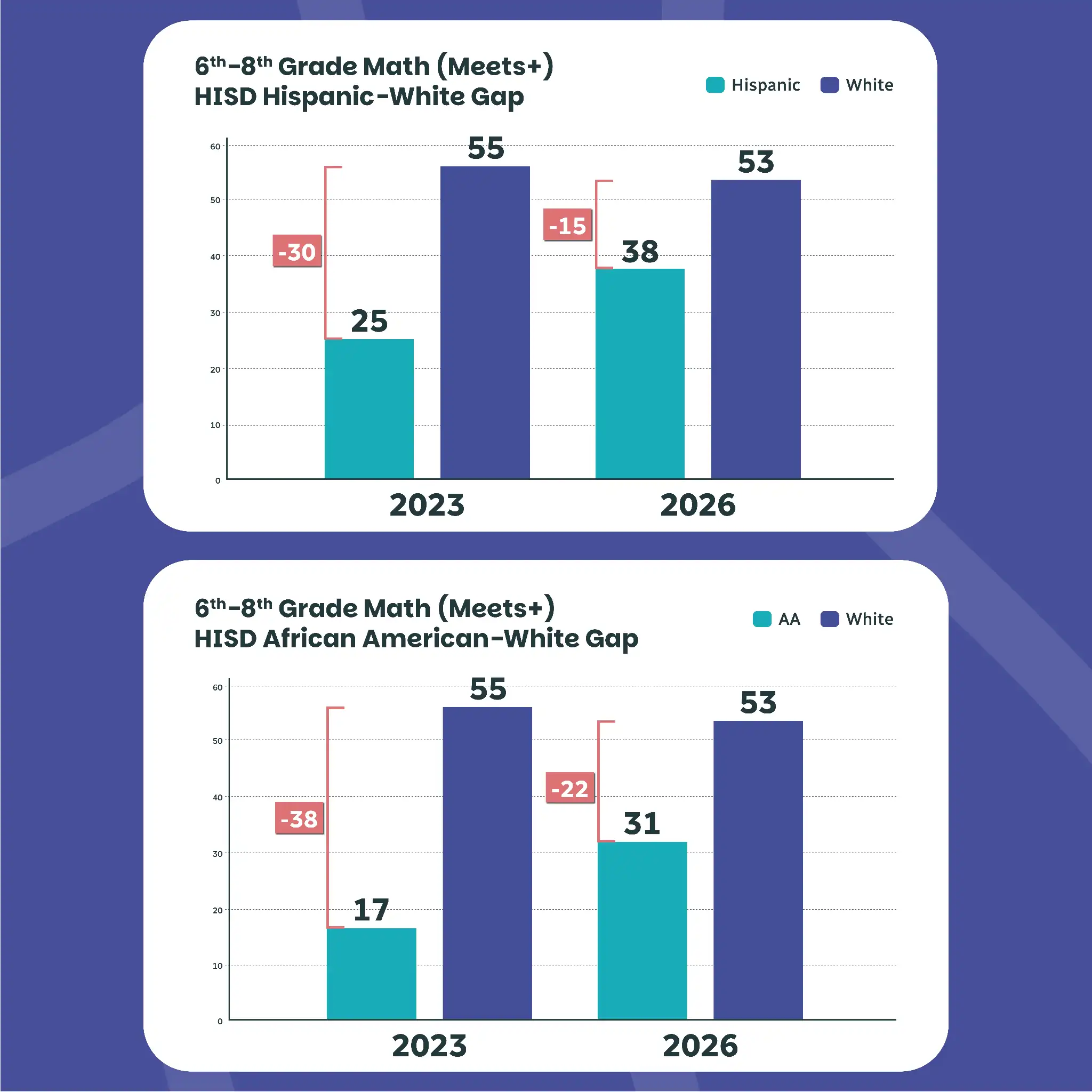
In grades 6 through 8 math, the percentage-point gap between Hispanic and White students earning Meets Grade Level or above fell from 30 points in 2023 to 15 points in 2026.
The Black-White gap narrowed from 38 percentage points to 22 points during the same period.
In 2023, 17% of Black students met grade level or above in grades 6–8 math, compared with 55% of White students. By 2026, Black student performance had increased to 31%, while White students were at 53%.
Hispanic students increased from 25% in 2023 to 38% in 2026, compared with 53% of White students.
Miles called the gaps particularly important because he said approximately 85% of HISD students are Black or Hispanic.
“We haven’t closed it, but we’ve narrowed it considerably in three years,” Miles said.
He credits additional resources and greater attention to instruction for helping students who historically have been further behind.
“We’re paying more attention and giving more resources,” Miles said. “Effective teachers as a resource, teacher apprentices, learning coaches, high-quality instruction, strong curriculum, and coaching on instruction.”
But even after the improvement, a 22-percentage-point gap remains between Black and White students meeting grade level in middle-school math, while the Hispanic-White gap remains 15 points.
Special education among HISD’s next areas of focus
Miles also identified special education as a major focus for the 2026-27 school year.
HISD has moved some self-contained special education classrooms into hubs or centers located within regular school campuses. Miles said one reason for the restructuring is the wide range of grade levels that had previously been grouped together in some self-contained classrooms.
According to Miles, about 65% of those classrooms previously included students spanning three, four or, in some cases, five different grade levels, creating instructional challenges for both teachers and students.
Miles said that after the restructuring, approximately 95% of the classrooms will contain students from only one or two grade levels, with a smaller number containing three.
“That’s going to be better for the student, better for the teacher,” Miles said.
The new STAAR scores and accountability ratings give HISD several measures of significant progress since 2023. But Miles said the district’s next challenge is making sure that improvement reaches students who remain below grade level — and continuing to close achievement gaps even at schools that are already earning top accountability ratings.
“The work isn’t done,” Miles said.
Some of HISD’s largest gains are in middle school
The racial achievement-gap numbers are part of a broader improvement HISD has reported since 2023.
According to the district, the percentage of students in grades 3–8 meeting grade-level standards has increased since 2023 on every released assessment except the traditional seventh-grade math test.
Across those grades, HISD says Meets Grade Level performance has increased by an average of 10.3 percentage points in reading, 7.7 points in math and six points in social studies since 2023.
Some of the largest gains have occurred in middle school:
- 8th-grade math: +19 percentage points
- 6th-grade reading: +13 points
- Combined 7th-grade math performance: +13 points
- 6th-grade math: +12 points
- 8th-grade reading: +12 points
- 4th-grade reading: +14 points
HISD says that before NES was implemented in fall 2023, the district trailed the Texas average on all STAAR assessments. In 2026, 10 of the 12 third-through-eighth-grade math and reading assessments met or exceeded the statewide average.
HISD reported a decline on the traditional seventh-grade math STAAR assessment. But both HISD and the Texas Education Agency caution against interpreting that decline as evidence that seventh graders overall are performing worse in math.
That’s because increasing numbers of high-performing seventh graders are taking more advanced assessments instead.
Some seventh graders now take the eighth-grade math STAAR or Algebra I end-of-course exam rather than the seventh-grade assessment. As more advanced students move into those tests, the population remaining in the traditional seventh-grade testing group changes.
When HISD combines the performance of seventh graders taking seventh-grade math, eighth-grade math and Algebra I, the district says the percentage reaching grade level has actually increased 13 percentage points since 2023.
The same phenomenon is happening statewide.
TEA reports that in 2026, 32% of all Texas seventh graders took the eighth-grade mathematics STAAR, compared with just 16% in 2023. In three years, Texas has effectively doubled the share of seventh graders accessing that advanced math pathway.
Statewide math results analyzed by students’ enrolled grade — rather than simply which assessment they took — show Meets Grade Level performance increasing in grades 6, 7, 8 and 9 in 2026.
HISD’s gains come as Texas math performance improves
The statewide numbers provide additional context for HISD’s results.
TEA reported gains in math and social studies in 2026, while reading performance was largely stable. Fourth-grade math had the state’s largest year-over-year increase, rising four percentage points.
Across grades 3–8 math, 43% of Texas students met grade level in 2026, compared with 42% in 2025, 40% in 2024 and 42% in 2023.
That statewide trajectory is important when examining HISD’s double-digit gains in some grades. Texas students are improving in math overall, but HISD’s increases in areas such as eighth-grade math are substantially larger than the statewide movement.
Reading presents a similar comparison. Statewide, grades 3–8 reading performance was largely stable or improved modestly in 2026. Grade 8 increased three points from 2025, grade 7 increased two points, grades 4 through 6 were unchanged and grade 3 declined one point.
HISD, meanwhile, reports increases of 13 points in sixth-grade reading and 12 points in eighth-grade reading since 2023.
