
HOUSTON – Harris County voters have been called to the polls again and again over the last several months.
November’s general election. December runoff elections. A January special runoff. March primaries. April and May special elections
For election workers, it’s nonstop. For taxpayers, it’s expensive.
Before counting May’s runoff elections, Harris County has already spent nearly $5 million on elections according to county figures reviewed by KPRC 2 News.
That money comes from local tax dollars, every time voters are asked to return to the polls.
And the costs keep adding up.
In 2024 alone, Harris County spent roughly $15.6 million conducting primary elections and runoff contests, according to county election data.
Now, county leaders and election reform advocates are asking a bigger question: can Harris County reduce repeat elections and save taxpayers money without changing who gets a voice in the process?
“Elections are very expensive”
“When it comes to costs for the third largest county in the nation, the largest county in the state of Texas, elections are very expensive,” Harris County Clerk Teneshia Hudspeth told KPRC 2 News’s Rilwan Balogun. “This is a massive operation here in Harris County.”
Hudspeth says many voters do not realize the scale of the operation required to run elections across Harris County. The county oversees elections for city, county, state, and federal races functioning almost like a contractor for every jurisdiction holding an election.
Hudspeth says the costs start long before voters cast ballots.
“Election workers are trained and they are paid. We have to evaluate all that equipment before it goes into the field,” Hudspeth explained. “We audit the equipment, prepare ballot language, provide translations, and after voting concludes, all machines and paperwork have to come back for audits and hand counts.”
Facilities are another major expense.
“The county clerk’s office, we don’t have the authority to say, ‘Hey, you have to be a polling location and make your facility free,’” Hudspeth said. “On average, we have more than 80 early voting sites. On Election Day, anywhere from 500 to 700 polling locations. So just on facilities alone is a high-cost factor.”
According to Hudspeth, the county has conducted eight elections in less than a year.
“November, December, January, March primaries, then a special election for the City of Houston, then May 2nd, then a runoff, then the May 26th primary runoff,” Hudspeth said. “Eight elections nonstop.”
Could election dates be combined?
Hudspeth says one possible solution may not require changing how Texans vote but when they vote.
Texas law currently restricts many elections from being consolidated during primary election periods, forcing counties to conduct separate elections for vacancies and runoff races.
“There is a way to streamline,” Hudspeth said. “When elected officials vacate seats and cause a vacancy, it would be really great for those elections to take place on the next uniform election date rather than prescribing its own election date.”
Hudspeth says combining races onto fewer election dates could reduce staffing, facility, and equipment costs.
“It’s really important to create these dates in a way that makes it feasible for counties,” she said. “It’s more cost-effective. We’re being fiscally responsible in making sure that we can get those races all on one particular date.”
What is Ranked Choice Voting?
Some election reform advocates believe another option could dramatically reduce the need for runoff elections altogether: ranked choice voting, also called instant runoff voting.
The system is already used in places including Alaska and New York City.
Instead of selecting just one candidate, voters rank candidates in order of preference: first choice, second choice, third choice, and so on.
If no candidate receives a majority of first-choice votes, the lowest-performing candidate is eliminated. Those ballots are then reassigned to voters’ next preferred candidate. The process repeats until one candidate earns a majority.
Supporters say the system effectively conducts a runoff instantly without requiring voters to return weeks later for another election.
Mary Beth Gilbert with Instant Runoff Voting for Texas says the system captures voter preferences while turnout is highest. Gilbert argues Texas taxpayers are paying repeatedly for duplicate election infrastructure.
“You’re putting out the same machines, paying the same clerks, the same administrative fees, you’re doing it all a second time,” Gilbert said.
In January alone, one runoff election cost approximately $1.6 million for a single race.
“Taxpayers are paying,” Gilbert said. “Whether it is the secretary of state, counties, cities they’re all tax-collecting organizations and we’re paying for it.”
Gilbert says ranked choice voting could save both money and time.
“Texas is a conservative state, and part of conservatism is an effective use of taxpayer dollars,” she said. “Millions and millions of dollars can be saved.”
Hudspeth agrees the idea deserves discussion though she noted any major election changes would require approval from the Texas Legislature.
“Can Harris County in a state like Texas benefit from ranked choice voting? Absolutely,” Hudspeth said. “But this is really something that the Texas Legislature would have to say, ‘we want to really dive into this.’”
FairVote research shows turnout drops in runoffs
A 2024 report from the nonpartisan election reform organization FairVote found that runoff elections often experience dramatic declines in voter participation.
According to the report:
- Since 1994, 97% of congressional primary runoffs have seen lower turnout than the original election.
- In 2024, runoff turnout dropped by 63% compared to initial primaries.
- FairVote estimates federal primary runoffs cost taxpayers between $6.9 million and $12 million in 2024 alone.
- The group also found that most runoff winners actually received fewer total votes in the runoff than they did in the original election.
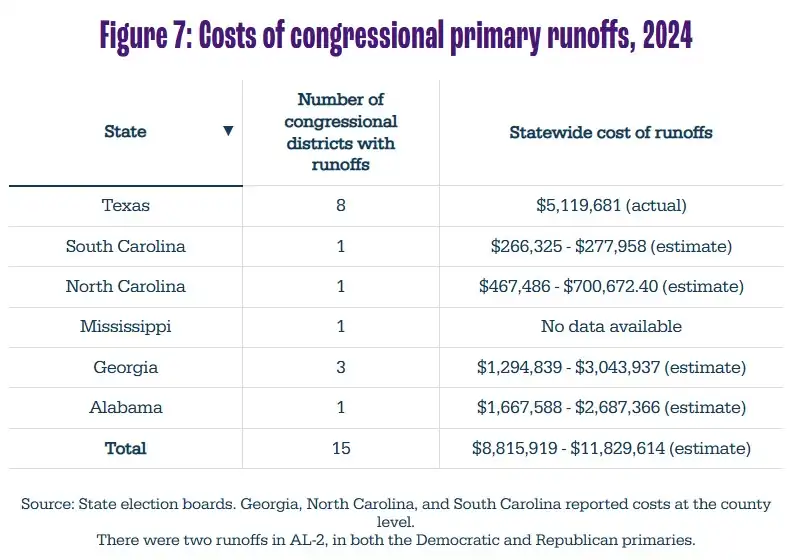
FairVote argues ranked choice voting functions as an “instant runoff,” allowing elections to be decided in one trip to the polls while turnout is highest.
The organization also says research suggests ranked choice voting can reduce negative campaigning because candidates have incentives to appeal to voters beyond their core supporters.
Texas Republicans oppose Ranked Choice Voting
But despite growing national interest in ranked choice voting, opposition in Texas remains strong especially among Republicans.
In 2023, the Republican Party of Texas passed a resolution formally opposing ranked choice voting.
The resolution argued that ranked choice systems can create “ballot exhaustion,” referring to ballots that become inactive if voters do not rank enough candidates.
The party also stated that ranked choice voting could “increase election distrust,” “disenfranchise voters,” and create “costly and confusing technology.”
The resolution added that Republicans want to keep voting “simple and secure.”
KPRC 2 News reached out to the Republican Party of Texas for comment but did not hear back.
Gilbert acknowledges skepticism exists.
“I think there is some distrust of instant runoff voting because of how it’s been used in other states,” she said. “Texas is unique. Every state is unique.”
Critics of ranked choice voting also argue voters may not want to rank multiple candidates.
Gilbert counters that voters are not required to rank more than one.
“There’s no need to rank any more than one candidate,” she said. “But you have an opportunity to express support for other candidates.”
The bigger question: How can counties save?
For now, any changes to Texas election law would have to come from lawmakers in Austin.
But with election costs climbing and voters repeatedly being called back to the polls, county officials say the current system may not be sustainable long term.
Hudspeth says even if Texas never adopts ranked choice voting, lawmakers should still consider ways to reduce the number of separate election dates counties are forced to administer.
“The state law now says no other elections can take place during a primary election,” Hudspeth said. “But if there’s a special election within a certain timeframe, it would make sense to hold it on the next uniform election date.”
Hudspeth says consolidating elections could make the process more efficient for counties across Texas.
“It’s really important to create these dates in a way that makes it feasible for counties,” she said. “It’s more cost-effective and fiscally responsible.”
If lawmakers eventually change the rules, it could mean fewer election days, fewer trips to the polls and potentially millions of taxpayer dollars used elsewhere.

More Stories Like This In Our Email Newsletter

