
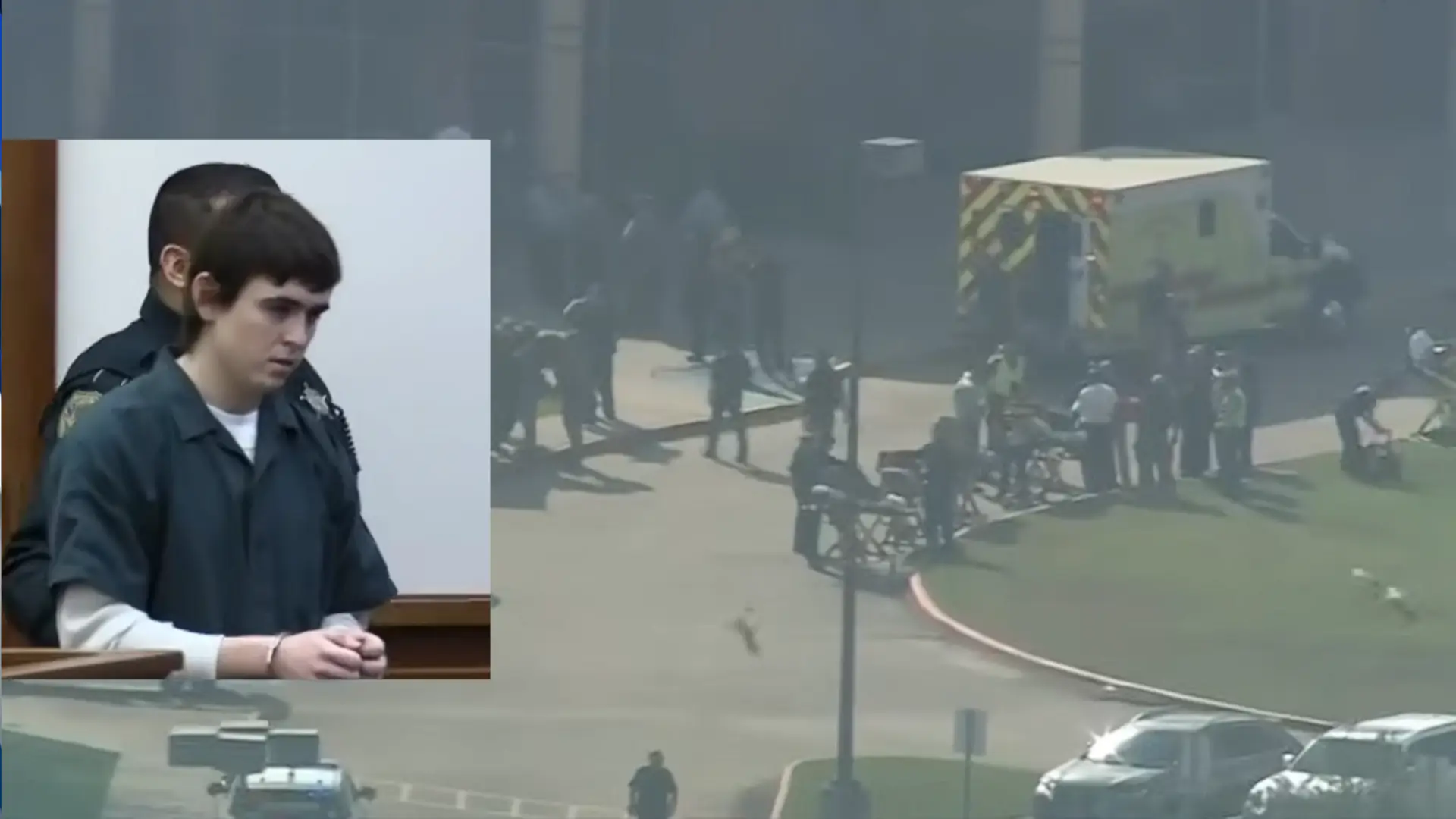
HOUSTON – On May 18, 2018, a student at Santa Fe High School walked onto campus and opened fire on classmates and staff members.
Students Jared Black, Shana Fisher, Christian Garcia, Kyle McLeod, Angelique Ramirez, Sabika Sheikh, Chris Stone, and Kimberly Vaughan were killed.
Recommended Videos
Educators Cynthia Tisdale and Glenda Ann Perkins were also killed, and 13 people were injured.
Criminal cases stalled
Dimitrios Pagourtzis, who was 17 at the time of the mass shooting, was arrested and charged with capital murder and aggravated assault on a public servant.
In April 2019, Pagourtzis was also charged with federal crimes related to the mass shooting. However, he has never gone to trial, and the criminal cases against him remain in limbo.
In November 2019, Pagourtzis was declared incompetent to stand trial. He was sent to North Texas State Hospital. Doctors have been unable to restore his competency.
Defense attorney Nick Poehl said Pagourtzis does not have a rational or factual understanding of the proceedings against him, nor can he aid in his own defense.
“We visited in January and met with his treatment team. They described him as the sickest individual in the hospital,” Poehl said. “What people need to understand is that it’s a unanimous scientific opinion.”
According to data from the Texas Health and Human Services Commission, doctors at the Vernon campus restored a person’s competency in an average of 134 days. Pagourtzis has been at the hospital for 2,359 days. He is one of four patients at the Vernon campus who has been there longer than five years.
The average daily cost of treatment is $949, according to HHSC.
“He’s not sitting under a shade tree reading a book. His day consists of individual therapy, group therapy, this library assignment, meals, and more therapy,” Poehl said.
Family members who lost loved ones and survivors of the shooting question how Pagourtzis can have a “library assignment” if he is incompetent.
“It’s part of his therapy. It’s highly supervised. It’s for a few hours a day,” Poehl said. “He works in the library. He checks out books, returns books, and re-shelves books.”
“How many doctors have reviewed his competency?” asked 2 Investigates reporter Robert Arnold.
“The number is approaching 20 at this point, thereabouts,” Poehl said.
The Galveston County District Attorney’s Office and the judge presiding over the case review doctors’ progress annually before signing recommitment orders. Given the length of time Pagourtzis has remained at North Texas State Hospital, families of victims are now asking the Galveston County District Attorney’s Office to hand the case over to the United States Attorney’s Office.
“If we don’t have a trial, we would like him to be in federal custody,” said Flo Rice, a substitute teacher who was shot in both legs during the mass shooting.
“We’re trying to work on that right now,” said Rice’s husband, Scot Rice. “See if we can get him moved into a different hospital setting. I don’t believe the state of Texas is prepared for this.”
In January, Galveston County District Attorney Ken Cusick said he was considering finding an independent doctor to evaluate Pagourtzis’ competency. When asked about handing the case over to federal authorities, Cusick had “no comment at this time.”
The fight for accountability, justice
“I stay hopeful because of Chris. He started a fight on May 18 and he didn’t give up. So I think, as his mom, I should not give up either,” said Rosie Stone.
Stone’s son, Chris, was killed while using his body to barricade a door against the gunman. His actions are credited with saving several lives, and he was awarded the Congressional Medal of Honor Young Hero Award.
“The hope of justice. Hopefully one day he will be competent and he will stand trial,” said Gail McLeod, whose son Kyle was killed during the mass shooting.
In addition to the criminal investigation, families of victims have continually pushed for a third-party independent review of what led up to the shooting and the school district’s response.
“Since day one, we’ve been asking for a third-party investigation, an independent review, an after-action report — whatever you want to call it — like they had in Parkland, like they had in Uvalde,” Scot Rice said.
After continuous pressure from families, the Santa Fe Independent School District school board in October 2024 asked the United States Department of Justice to conduct a technical review of the district’s campus safety and security policies and procedures.
According to a DOJ spokesperson, the review was completed in March 2026.
“In October 2024, SFISD and SFISDPD requested technical assistance from the U.S. Department of Justice’s Office of Community Oriented Policing Services in the form of an external, independent best-practices review of policies, procedures, operational protocols, and training associated with campus safety and security. That review was completed in March 2026, and the findings and recommendations were provided directly to SFISD and SFISDPD. The scope of this Critical Response engagement was limited to the district’s current state of safety and security, and thus the assessment team did not analyze any aspect of the 2018 shooting,” a DOJ spokesperson wrote.
Officials with Santa Fe ISD told 2 Investigates the school board has not yet “collectively reviewed” the report, and more information will be released afterward.
“Leading up to it, who didn’t do their job? Who could have maybe caught him, stopped him, or done something else to head off that day?” McLeod said.
Families of victims also sued Pagourtzis’ parents, arguing they were partially responsible because the guns used in the shooting came from their home. In August 2024, a jury found Pagourtzis’ parents were not liable for the mass shooting.
Families and survivors have also helped push laws regarding threat reporting, campus security measures, and victims’ rights to view evidence in murder cases that have not gone to trial.
Flo Rice joined Teachers Unify to End Gun Violence to continue advocating for safe storage laws and gun safety education. Stone said she plans to work with state lawmakers during the 2027 legislative session to pass “Stone Law.”
Stone said one proposed requirement under “Stone Law” would mandate third-party independent reviews following all school shootings. Stone, the Rices, and McLeod also want school shooters classified as domestic terrorists.
A fight for disability pay
John Barnes was the first officer to confront Pagourtzis. A shotgun blast tore through an artery in Barnes’ arm, and his heart stopped twice the day of the shooting.
“I can’t go back to work as a cop again,” Barnes said.
Barnes’ injuries forced him to medically retire from law enforcement. In addition to surgeries to repair his arm and extensive rehabilitation, he underwent two elbow replacement surgeries. One surgery involved an unhinged elbow that Barnes said did not work. A second surgery that gave him a hinged elbow successfully reduced his pain.
“I can’t raise my arm above my head,” Barnes said. “There’s lots of things I can’t do.”
“Do you have a weight limit on what you can pick up?” Arnold asked.
“Yeah, 10 pounds forever. I have a 10-pound weight limit,” Barnes said.
In the years since the shooting, Barnes said he learned hard lessons about disability payments for school district police officers. After retiring from the Houston Police Department, Barnes joined Santa Fe ISD and, like all other ISD police officers in Texas, was placed under the Teacher Retirement System of Texas.
“They pay for my medical stuff, but they don’t pay for me not working,” Barnes said. “Everyone assumes there was some big payout or that I got rich from this. I’m in a rent house. I had to sell my house because I could not afford surgery unless I sold my house, because I couldn’t work when I had surgery.”
Barnes had been with Santa Fe ISD for only four months when he was shot. He later learned he needed to be under TRS for at least 10 years to receive full disability benefits.
According to the TRS website, employees can qualify for disability retirement if they have “at least 10 years of service credit.” Employees with less than 10 years of service credit can receive a disability retirement benefit of $150 per month for “the lesser of the number of months you have been covered by TRS, the duration of your disability, or your lifetime.”
Combined Law Enforcement Associations of Texas, or CLEAT, has spent more than a decade trying to persuade lawmakers to change retirement and disability benefits for ISD and state university police officers.
“The current model reflects great disparity between these police officers and almost all others across the state when it comes to retirement and disability. This is not sustainable for the future of campus law enforcement officers in Texas,” wrote CLEAT Deputy Executive Director Jennifer Szimanski.
CLEAT said legislation addressing the issue failed during the last session but remains a priority heading into the 2027 legislative session.
Greg Bonnen, whose district includes Santa Fe, also released a statement supporting efforts to improve disability protections for ISD police officers.
“My heart continues to go out to Officer Barnes and the entire Santa Fe community,” Bonnen wrote. “No officer who risks their life protecting students and educators should be left without adequate disability protections afterward.”
Barnes also applied for benefits through the federal Public Safety Officers Benefits Program. After waiting five years, Barnes said his application was denied.
Barnes said he was told he medically qualified for compensation, but because he worked between surgeries, he did not qualify.
Barnes said he appealed the decision and has now waited a year and a half for a hearing date.

