

HOUSTON – Texas has more uncertified teachers in its classrooms than any other state in the country, driven by a nationwide shortage of state-certified educators, a certification process that can take years to complete and a push by many school districts to cut costs.
Uncertified teachers are often cheaper to employ.
Recommended Videos
Houston Independent School District is among the most prominent examples. Last school year, approximately 2,500 HISD teachers lacked state certification — roughly a quarter of the district’s total teaching staff.
The issue has three distinct sides: students and parents, teachers, and the school districts responsible for managing them.
Teachers union, District at odds over training
The Houston Federation of Teachers says the influx of uncredentialed educators is a problem — and that HISD Superintendent Mike Miles is not doing enough to train them.
“Well, bottom line is this,” Corina Ortiz, Chief of Staff for the Houston Federation of Teachers, said. “If you don’t tell these uncertified people coming in how to get their certification, or show them, or help them, then how are they going to do it?”
RELATED: HISD cuts campus budgets and positions as enrollment falls
Miles pushed back firmly on that characterization.
“We do the best professional development, our teachers are effective on day one,” Miles said. “We do a lot of training, so the teachers union doesn’t know what the heck they’re talking about.”
Miles himself is not state-certified as a superintendent. He operates on a waiver — similar to the temporary state authorization thousands of his teachers use to work.
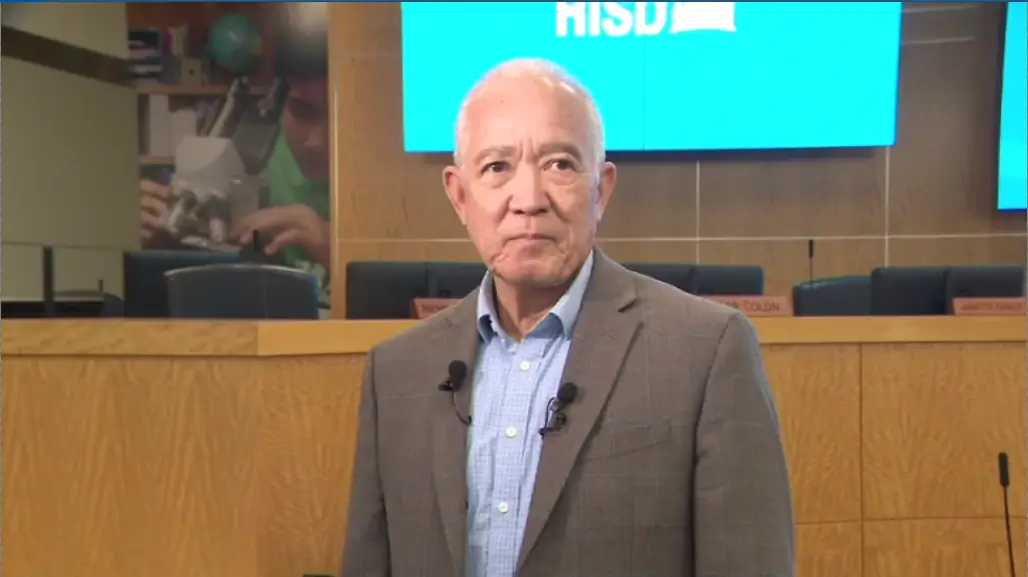
Miles has also signaled a broader philosophical shift on the issue.
“Maybe we need to shift our mindset on uncertified,” Miles said at a recent press conference.
When pressed by ENOUGH’s Joel Eisenbaum on whether HISD is bringing provisionally licensed teachers to full certification within the state’s required timeframe, Miles responded: “Yes, and I will answer that question in a second.”
Miles did return to the question a few moments later.
“We have a rigorous pay for performance, so we actually know who our most effective teachers are. And those teachers are being retained at 89 percent if you’re exemplary, 82 or 83 percent if your proficient one, and for proficient two, it’s somewhere in between. So, those are high retention rates. And that’s the measure of success,” Miles said.
How to check your child’s teacher’s certification status
Parents can check a teacher’s certification status in just three steps directly from their phones:
Get the teacher’s first and last name.
Google “TEA Certificate Lookup.”
Enter the name and look at the result. A Standard certificate means the teacher is certified. Provisional or Probationary are indicators the teacher is not yet fully certified.
State timeline, waivers, a missed deadline question
Under Texas Education Agency guidelines, provisionally licensed teachers are expected to complete all certification requirements — including required training and testing — within a set timeframe.
The TEA states: “If you do not complete all requirements within one year, it is sometimes possible to extend the probationary certificate for up to two years.”
However, ENOUGH’s reporting found that HISD has been seeking waivers that extend beyond that two-year deadline, and the state has been allowing a third year in many cases.
A letter obtained by ENOUGH — sent to provisionally licensed teachers who missed state deadlines and subsequently lost their jobs — sheds light on the situation.
“When your employment with Houston ISD ended, it was because you had reached the certification timeline that was in place,” the letter read.
But the letter continued: “Since then, we’ve received additional certification waiver options that may allow certain teachers to continue teaching while completing their certification requirements.”
When Eisenbaum brought the letter to an interview with Elizabell Garcia, HISD’s senior executive of teacher pathways and certification, her response raised more questions.
“No, this is an HR letter,” Garcia said when asked about her knowledge of the correspondence.
“HR. Everything’s HR. Am I talking to the right person?” Eisenbaum replied.
A spokesperson present at the interview confirmed Garcia could speak to uncertified teachers earning certification and the training HISD provides.
Where uncertified teachers are placed — who decides?
Beyond the question of certification timelines, ENOUGH’s reporting also examined where uncertified teachers are being placed within the district.
The Houston Federation of Teachers says the pattern is clear.
“We saw the same thing,” Ortiz said. “Now the question is, why? Well, very simple. In those low socioeconomic neighborhoods, areas, you don’t have the parent involvement that you have in, let’s say, a West U or the River Oaks. And so he’s not going to get any pushback. So it’s OK if I just put this person over here. And if they struggle, well, it’s OK, we’ll make do. And as opposed to a West U where the parents are constantly going to be at the school, they’re going to keep up with their kids.”
When Eisenbaum asked Garcia directly how HISD decides where an uncertified teacher is placed, she deferred.
“That would be a question maybe for HR, I don’t have the answer to that question. I’m sorry,” Garcia said.
That answer sent Eisenbaum back to HISD headquarters for a press availability with Miles.
“I’m talking about where they’re placed within the district,” Eisenbaum told Miles. “It seems like they’re going to the most challenged schools instead of being spread evenly across the district.”
Miles did not dispute the pattern but challenged the framing.
“We don’t have a policy of spreading the uncertified teachers across the district,” Miles said. “That depends on every school and whether or not every school is able to hire certified versus uncertified. But I’m going to say again, so we’re not speaking past each other, that even in the cases where the schools have uncertified teachers, they’re gaining gains. And so that’s the important thing. It’s not where they’re placed.”
Sam Houston High among schools with most uncertified teachers
The data backs up concerns about placement. Sam Houston Math Science and Technology Center High School — still widely known as Sam Houston High — was the top HISD school for the most uncertified teachers during the 2024-25 school year. It ranked second the prior school year.
The school sits on Houston’s northeast side, just off the Hardy Toll Road, in a neighborhood that has seen its share of challenges. ENOUGH previously reported on Sam Houston High School in connection with truancy issues and a shootout involving students in front of the building.
A resident who has lived in the neighborhood for 20 years told Eisenbaum the responsibility is clear: it’s up to the district where teachers are assigned.
Miles maintains that teachers — certified or not — go where they are needed. And he can point to measurable progress. Using the state’s school accountability ratings system, 205 HISD schools earned an A or B rating in 2026, compared to 93 when Miles arrived in 2023. The number of D and F-rated schools dropped from 120 in 2023 to 13 in 2026.
State law tightens rules on uncertified teachers
Many social media users who responded to ENOUGH’s coverage were supportive of uncertified teachers, arguing that certification does not equal classroom effectiveness. But regardless of public opinion, schools must comply with state law — and that law is getting stricter.
Lawmakers passed House Bill 2 during the last legislative session, setting limitations on which subjects uncertified teachers can teach — including core subjects like math and English — and establishing a timeline to reduce the reliance on uncertified teachers by 2030.
That is a significant challenge for HISD. The district employed nearly 2,200 uncertified teachers two years ago. That number dropped to just under 2,000 by the end of last school year. Over those two years, 683 previously uncertified HISD teachers completed their certifications.
An HISD spokesperson said that the school district fully intends to comply with state law.
