
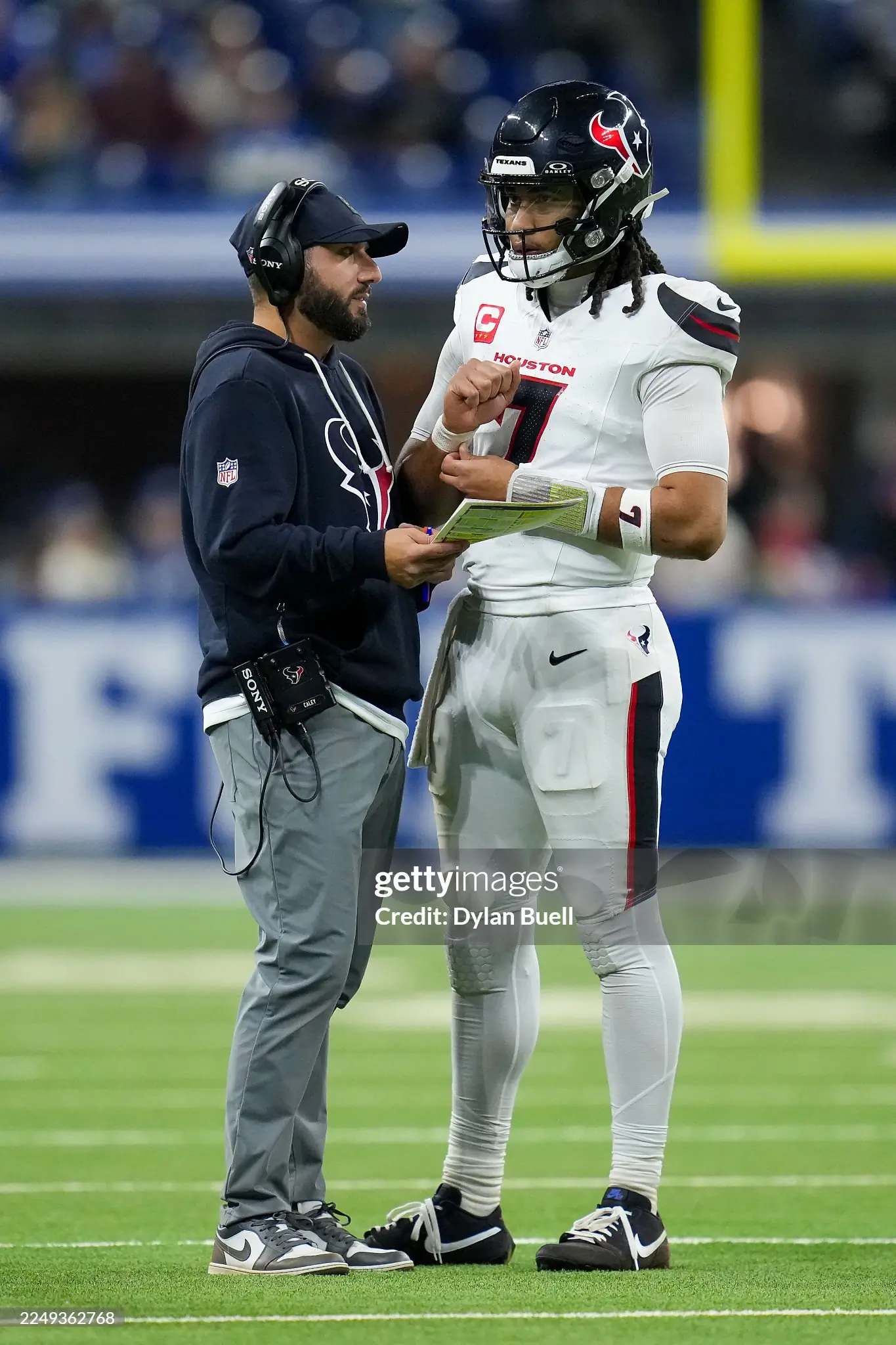
HOUSTON – Standing a few yards behind quarterback C.J. Stroud, offensive coordinator Nick Caley was in a perfect vantage point to watch the play unfold.
From the shotgun snap, to how Stroud read the Texans’ top-ranked defense, to the pass protection of an overhauled offensive line and watching the former NFL Offensive Rookie of the Year deliver a spiral into the waiting hands of wide receiver Jaylin Noel.
Recommended Videos
It was a textbook play during the Texans’ recent minicamp. And Caley and the Texans hope that snapshot and other similar sequences represent a snapshot of an improved offense with a new emphasis on increased tempo in the passing game balanced by a punishing running game headlined by veteran running back David Montgomery.
Texans coach DeMeco Ryans has repeatedly referenced vast improvement from the offense in terms of efficiency, nothing how a year ago in these practice sessions there were struggles to even snap the football and get the play orchestrated against the top-ranked defense in the NFL.
In the second year of Caley running the Texans’ offense, there’s a lot more confidence in terms of how the offense is being run, to the speed and ease of communicating the play call to Stroud and getting hurried up to the line of scrimmage to survey the defense. Increased knowledge of what Caley envisions from an offense steeped in his background with the New England Patriots and offensive coordinator Josh McDaniels and quarterback Tom Brady should allow the Texans to upgrade their offense significantly.
“Sure, it’s growth,” Caley said. “It’s year two. We should be further along. You talk about just overall understanding of the offense. Last year, we’re teaching the language for the first time at this time of the year. It’s the what is this concept? What’s it called? What are the details of it? I think last year there’s things we did this time of the year that we ended up getting away from for a variety of reasons, whether that was not really fitting what we wanted to do, personnel.
“You have guys that have experience in the system, in the verbiage, and now we’re a step ahead. Things are processing faster. How can we make them better? How can we learn from things last year good and bad? The best thing I’ve taken from this spring is just a hungry, ambitious group. It’s been a good progression. Got a ways to go, but I’ve been very, very pleased with where we’re at year two as opposed to a year ago.”
The debut of the Texans’ offense was mixed bag last season.
There was a significant improvement in pass protection as Stroud was sacked just 23 times under the direction of Caley and offensive line coach-run game coordinator Cole Popovich one year after being sacked a career-high 54 times in his second NFL season.
Playing without Pro Bowl running back Joe Mixon due to a mysterious, foot injury whose complications led to him missing the entire season severely hamstrung the offense.
The Texans shelved five-time Pro Bowl runner Nick Chubb when he appeared to have lost his old burst and went with rookie Woody Marks as the primary running back.
Stroud missed three games with a concussion during the regular season. The former NFL Offensive Rookie of the Year uncharacteristically struggled with ball security in the playoffs with five combined interceptions and five fumbles in two postseason games, including a career-high four interceptions in a divisional round playoff loss to the New England Patriots at snowy Gillette Stadium.
Nonetheless, the Texans finished 13th in scoring with a 23.8 points per game average and 18th in total offense with a 327 yard average per contest. In the final season before offensive coordinator Bobby Slowik was fired, the Texans were 19th in scoring and 22nd in yards per game.
And Ryans sees a distinct difference in the offense, ranging from the rough moments of last year to now.
“When I go back and look at film from our last year practices, we had trouble just snapping the football, getting plays started,” Ryans said. “Communication, the play clock going down in last year’s practice. When I say we’re ahead, we’re ahead. We’re doing a better job with our cadence from the quarterback position. All three guys are using voice inflection really well.
“They’re getting our defensive line to jump offsides several times. They’re using their snap points, the cadence, the rhythm and timing, they’re changing it up a lot, which does wonders for an offense when you talk about operating fast and you operate at your pace. You control the tempo and our offense is doing a better job at controlling the tempo this year. I’m excited to see how we keep going with it. We’re light years ahead of where we were last year.”
And key players in the offense are noticing the changes reflected by Caley and how that is causing a ripple effect on plays’.
It’s a matter of using the time allotted before plays to position the offense for maximum chances of success.
That involves a faster process all-around.
“Yeah, I feel like it’s really just getting the play call, getting in the huddle, hear it, and running out of the huddle, getting lined up and seeing where the defense is,” Texans Pro Bowl wide receiver Nico Collins said. “That’s pretty much the pre-snap situation. As an offense you want to hurry up because the play clock is going and you’ve got 25 seconds and it’s clicking by the time they roll it in. By the time you get to play, it’s about 15 seconds. That’s the pre-snap urgency we need.
“Go out, get lined up, see what the defense is in, wide outs, see who the safeties are, if you’re hot or not, communicate that with C.J., the quarterback. A lot goes on before you say hike, before you call snap. I feel like that’s things we’re working on now in two-minute, just hurry-up offense so on Sundays we’re not thinking about it. If we say we want to change the play, put you on this route, it’s natural.”
The collaboration between Caley, in his second season calling plays after previously working for the Patriots as a tight ends and fullbacks coach and under Los Angeles Rams coach Sean McVay as a tight ends coach and pass game specialist, and Stroud, a former second overall pick and Heisman Trophy finalist from Ohio State, heading into his fourth season is a pivotal element for the Texans.
Both Stroud, a California native with a low-key personality, and Caley, an Ohio native known for his intense, high-octane approach, have outlined a strong relationship.
“I’ve always had a good relationship with C.J.,” Caley said. “We always have transparent and honest conversations, but you’re always trying to dive deeper, to continue to expand those finer points of the relationship. It’s great. We get to talk ball. We’re highly collaborative. He has great perspective on it.
“He sees the game really, really well. So I’ve had a blast being around him every single day, just like last year. And we’ve gotten to take it a step further, just more time on task, more time in the film room, more opportunities to evolve and do some different things here from an offensive standpoint. It’s been a hell of a lot of fun.”
From the standpoint of Stroud, he likes what he’s seeing from Caley. They’re on the same page.
“Yeah, definitely. I love Cales,” Stroud said Monday. “I think there’s growth in our relationship, there’s growth in his ability to call plays, growth and DeMeco trusted him.”
The Texans traded for Montgomery, a powerful running back, and signed him to a two-year, $16.5 million extension. The arrival of Montgomery should allow the Texans to build a punishing run game and become a better red-zone and play-action offense.
“He’s all-day tough,” Caley said of Montgomery, who was nicknamed ‘Knuckles’ while playing for the Detroit Lions. “His body of work will speak for itself. Runs behind his pads, stays grounded. Arm tackles aren’t getting it done. He’s going to try to run through you every single chance. He can sets guys up. He understands how to set blocks and to deliver and help deliver defenders to the blocker.
“He loves football. He’s very serious. He’s a true pro. I’ve admired him for a long time, dating back to when he was at Iowa State. He’s a Cincinnati guy. He’s tough. He embodies everything we want here with our team and with our offense. I’m really, really happy that he’s a part of our team. He’s made an impact. You can feel him.”
The Texans retained right guard Ed Ingram on a three-year, $37.5 million contract and former Pro Bowl swing tackle Trent Brown with a one-year, $7 million deal. They signed left guard Wyatt Teller, a Pro Bowl selection with the Cleveland Browns, to a two-year, $23 million deal and right tackle Braden Smith to a two-year, $25 million contract during free agency. They drafted offensive guard-center Keylan ‘Big Red’ Rutledge in the first round out of Georgia Tech.
“I’m excited to have the new guys,” Stroud said. “I’m grateful that we’re beefing up the offensive line. We’ve got some guys in here who’ve played a lot of meaningful ball and they want to compete and they want to help me and they want to help this offense.
“They want to help the Texans. So, I’m very excited to have them and I think we’re trending up, we’re getting better and we’re attacking a lot of the things that we need to. Those guys are doing nothing, but just adding to it.”
The Texans named Jerry Schuplinski as quarterbacks coach, replacing Jerrod Johnson. And they extended tight end Dalton Schultz on a one-year, $12.6 million deal. They signed Collins to an upgraded contract that adds $17 million in raises over the next two years and includes a $27 million signing bonus.
Stroud definitely appreciates the reinforcements, and the financial commitment to the offense.
“I think we’ve taken a huge step from where we were last year to where we are now,” Stroud said. “Even in practice, we’re competing. We’ve got guys that want to play ball, want to do the right things, who have been here. I think the culture is starting to pick up on offense and we’re starting to get it together.”
Collins is seeing encouraging signs from Stroud. He sees a big season unfolding.
For his career, the former second overall pick, consensus All-American and Heisman Trophy finalist from Ohio State has completed 63.8 percent of his throws for 10,876 yards, 62 touchdowns and 25 interceptions.
“Different guy, different dude, man on a mission,” Collins told KPRC 2 during his annual youth football camp. “Man, he’s ready to hunt.”
Marks sees a similar approach from Stroud, who has been training with his teammates in Houston throughout the offseason conditioning program.
“Yeah, he’s been there since March 2, since we started the offseason workout, he’s been grinding,” Marks said. “Got a new look. He kind of told me the end of the season that he was going to cut his hair. I wasn’t believing it. He’s been working.
“Just seeing the quarterback, the leader of the team out there working in the offseason, not working somewhere else, putting in work at where he belongs at and that’s in Houston. He’s been doing a tremendous job. He got bigger and stronger. His times when we were running outside, he’s getting faster. I’d say he should be using his legs a lot this year, too.”
And Caley is running the show. He said he wants to increase the involvement of the tight ends with more 12 personnel (two tight ends) and even 13 personnel (three tight ends) along with a potential split-back look with Montgomery and Marks on the field at the same time.
The Texans also want to create more explosive plays with increased roles for second-year wide receivers Jayden Higgins and Noel.
“We’re further ahead now than we were at the end of the season, obviously further ahead than we were last year, so we’re just going to continue to try to do those things,” Caley said. “The explosives come by doing all the right thing consistently and having all 11 tied together in those things, and that’s where the opportunities come.
Then to piggy-back off of that, when you do have the ball your hand, how do we create more yards after the catch with the ball in our hands? Is it attacking leverage? Attacking entry? Being able to set up defenders in the open field. Those are all things we try to attack on a daily basis and have progress with.”
And Caley has devoted countless days, weeks and hours toward self-scouting to learn from what worked and what didn’t a year ago. He’s determined to transform the offense into a higher scoring threat than a year ago when the Texans were one of the least effective red-zone outfits and standout kicker Ka’imi Fairbairn tied David Akers’ NFL single-season record with 44 field goals.
The Texans need touchdowns, a lot more of them, to hold up their end of the bargain on a team led by an elite defense.
“You lift up the hood, and you always look at yourself under the hood,” Caley said. “I think the one thing, when we look back through last year, is how can we avoid getting into longer yardage situations? I think one thing for myself too is just trying to find those alternative ways is to be able to do those things on early downs. There’s going to be some games where the run game is going to get going, and there’s going to be games where it’s not going to go as well.
" I think just trying to evolve in the early down and distance phases. You talk about the evolution of that, you think you do it last year, but even more intentionality of putting guys in different positions. This is the time of year to do it, right? So, seeing what they can do, versatility. The receivers, do we have some inside to outside flex? Sure, we do and vice versa. So, getting those guys in position to be able to show what they can do here.
Aaron Wilson is a Texans and NFL reporter for KPRC 2 and click2houston.com