
TEXAS – This story is part of a reporting fellowship sponsored by the Association of Health Care Journalists and supported by The Commonwealth Fund.
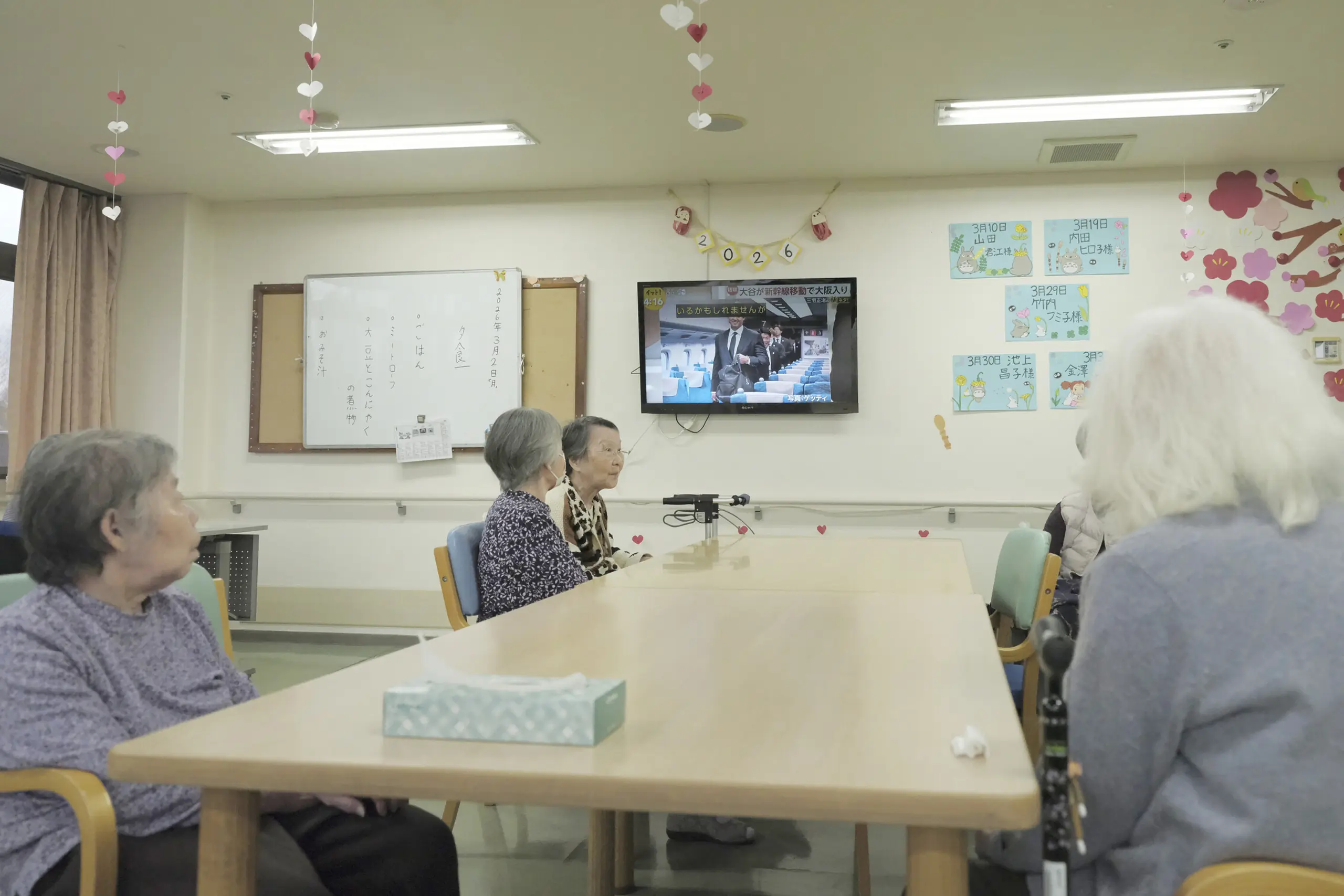
TOKYO — In Shibuya, home to one of Tokyo’s busiest train stations and shopping destinations, seniors can choose a monitoring service and the city will install it and pay for the service subscription for up to a year.
Recommended Videos
They can pick Hello Light, an LED lightbulb that autonomously sends text messages to caretakers when the light hasn’t been turned on for a while.
Or, MaBeee, a battery that powers TV remotes, lights and other small devices and alerts family members when they are not being used.
There’s also Bocco, which can store medication reminders, transmit weather alerts and tell when the home is too hot or too cold. A nod to Japan’s affinity for anthropomorphic packaging, the messaging device is shaped like a small snowman.
“One of the biggest problems we have in Japan, in this [elder care] industry, is the gap between the demand and the supply because there are a growing number of elderly people but we are understaffed,” said Masaru Yamaoka, general manager of Panasonic’s Smart Aging Project, one of many divisions housed within Japan’s corporate brands focused on technology for the aging population.
Finding sustainable, low-cost ways to care for the elderly population is a problem Texas is all too familiar with and Japan, home to the world’s largest over-65 population at 36 million, is beating Texas in solving.
The Best of the Tribune in your Inbox

Keep tabs on Texas politics and policy with our morning newsletter.
Chronic workforce shortages along with rising costs to care for a growing older population have prompted Japan — from companies to local governments — to heavily invest in technology to make it easier for family members to remotely monitor the elderly. The country’s aim is to keep aging residents in their homes, rather than in an expensive nursing home, for as long as they can.
Texas shares the same goal. Keeping older Texans healthier in their own home not only costs both the healthcare system less, but most people prefer it.
“I’ve never heard anyone say, ‘Gee, I hope I end up in a long-term care facility,” said Karen Fingerman, director of the Texas Aging and Longevity Center at the University of Texas at Austin. “If you’re going to have all this technology, which most of us have some, at least, wouldn’t it be better if it were more usable and it were designed as you get older to have the ability to help you stay in your own home?”


Compared to Japan, Texas has far fewer seniors at 4.4 million, but they are among the fastest growing population segments. By 2040, the number of older Texans will grow to 6.8 million and by 2060 reach 9.2 million.
Healthcare workforce shortages, sparse public transportation and spotty internet reliability, particularly in rural areas, where 28% of Texas’ over-65 population lives, isolate many older Texans and deprive them of access to healthcare, which can worsen their outcomes and accelerate the need for expensive residential care.
While most elderly Texans live in their own homes, roughly 80% of the 87,000 Texans who live in nursing homes are over the age of 65. Most of them rely on Medicaid, the insurance plan for low-income individuals, to pay for their care. Medicare, the insurance plan for Americans 65 and older, only covers short term stays following a hospitalization.
Medicaid spending on Texans over the age of 65 totaled over $8 billion in 2023, according to health policy researchers at KFF. Their analysis of Medicare, which pays for the bulk of healthcare costs for seniors, was $28 billion in Texas in 2021. The Texas Legislature, which reconvenes in January, has made the rising cost of healthcare a primary focus for next year, as it did in 2023.
“People want choices,” said Mark Hollis, spokesperson for AARP Texas. “They want options and they deserve to have good affordable safe options where they want to live out their lives.”
In Japan, building nursing homes to accommodate the next 20 years of aging baby boomers seems an expensive investment when the number of seniors in subsequent generations will eventually start to decline.
An estimated 2.7% of older Japanese, or about 1 million, live in residential care facilities. About 6.7 million Japanese over the age of 65 live alone and most of the rest live with family members, spouses, adult children or extended family. Japan’s community-based, government-funded home healthcare service help seniors live in their own homes. Still, more than 58,000 people over the age of 65 were found dead in their homes last year.
To keep seniors living independently and healthily, corporations and local governments in Japan have turned to developing and distributing at no cost to seniors ‘mimamori’ products, or monitoring technology. Less intrusive than a security camera, these drop-in services and personalized chatbots direct older residents on how to maintain their physical and mental health in their own home and keep an open line of communication with caregivers.
“In 2040, the number of elderly people who need [residential] care will decrease,” Panasonic’s Yamaoka said. “We are going to see many elderly people staying at home. That’s why we believe that these kind of systems will be necessary in Japan. And we also believe the communication model will be in demand.”
While Japan has worked for decades on making its transportation and cities elderly-friendly and it fared better than Western countries because of stricter infection controls, the pandemic revealed new vulnerabilities. “It became very difficult to rely entirely on human beings to visit elderly people, especially due to COVID,” said Akihiro Hioki, the aging services chief for Shibuya City, one of Tokyo’s 23 wards or districts.
That’s why taking a look at Japan’s less publicized age-tech world, one far from the gushy news streaming daily from robotics labs, could prove instructive for Texas.
“We don’t need, you know, an army of robots, just to make sure that mom’s good,” said Darryl Greer, a regional program manager for AARP’s Older Adults Technology Services, which offers digital literacy programs for seniors.
By 2021, Shibuya City embarked on an ambitious project: handing out 3,000 smart phones to its older residents preloaded with disaster and health apps. The phones gave residents better access to municipal notifications, forms and payment portals, as well as communication applications like Line, the Asian version of WhatsApp. The city also launched in-person classes on how to use them.
“We realized that we need to have a mixed solution with human power and also, technology,” Hioki said. By 2024, Shibuya declared the effort a success with more older residents switching from their old flip phones to smart phones.
Then, last year, Shibuya became one of several cities in Japan offering to install monitoring options, like Hello Light, MaBeee and Bocco, in older residents’ homes.
“COVID was a turning point,” said Yuichiro Suzuki, chief operating officer for Tokyo-based Yukai which makes Bocco. “So many people, in my generation, they were not able to go visit our parents.” They needed a way to check on family members that didn’t require boarding a bullet train to see them in person, he said.
It’s not clear exactly how many monitoring services are available nor a way to accurately capture exactly how many cities offer to front the costs for them. But, the Japanese see the technology as a way to ward off social isolation and depression that can greatly exacerbate a senior’s health problems.


“If elderly people feel they have a pain in the knee, they avoid going out many times, and then because of the less interaction, they might suffer depression,” Panasonic’s Yamaoka said. “And that’s kind of like a domino effect.” Health starts to deteriorate for the individual and hastens a move to a residential facility.
Companies have a vested interest in these devices because if their employees can offload some of their responsibilities of caretaking onto technology, they can remain more productive at work, Yamaoka said.
Many municipalities also pay for an app called Health Mileage created by cellphone service company NTT Docomo. To sign up, a participating organization, such as a local municipality, must first invite residents to join and they can use it to track their steps. Officials will also use the app to push out programs to encourage walking, such as new walking paths and events.
Local governments “will encourage their residents to use this application,” Satoshi Hiyama, NTT Docomo’s senior manager of Medical & Healthcare Tech Group, said. “Because if they have more healthy residents, they will reduce medical costs.”
More than a dozen cities also offer a partial subsidy to those over the age of 70 who live alone for NTT Docomo’s Chikaku, which means nearby. For less than $20 a month, the popular subscription-based device that’s shaped like a white house turns the user’s television set into a videophone and monitor. While there are some similar services in the U.S. like Grandpad or JubileeTV, The Texas Tribune was unable to locate a Texas city that subsidizes them for residents.
With permission of the older user, Chikaku allows remote relatives to use a phone app to login to their elderly loved one’s televisions to see if their parents are available for a call and conduct a chat from there.


Local and federal officials want to lower healthcare costs because in the country’s nationalized healthcare system, the government has to pay for most of it. Residents here pay about 30% of their care.
Unfettered healthcare access has allowed the rapidly growing older population to disproportionately use the system. Because the elderly often treat hospital waiting rooms like community centers, the Japanese often joke that if they don’t show up one day, they must actually be sick.
To brace for Japan’s silver tsunami, the federal government in 2000 started requiring workers aged 40 and older to pay a monthly long-term care insurance premium that subsidizes the country’s elder care services. Still, about 70% of Japan’s hospitals operate today at a loss.
Cities see technology as a way to bring down costs.
“We believe there is a growing demand among elderly people and their family members for these types of monitoring services,” said Hioki, Shibuya City’s aging services chief. “We need to work for the improvement of the welfare of the residents. That’s our task.”
What Texas could do today and learn from countries with far larger senior populations could help offset future healthcare costs.
The state’s Aging Texas Well strategic plan, a general roadmap for state, local and nonprofits stakeholders, identifies social isolation as a factor that can exacerbate health issues, details how residential care options are limited and expensive, and urges Texas leaders to make resources easier to locate and use.
“The overwhelming majority of older adults wish to age in place or age in their community to have the best quality of life,” the plan’s 2026-2027 update stated. “Moreover, it is more cost effective to assist older adults and their family caregivers to do this through long-term supportive services than it is to age in an institutional or nursing home setting.”
Other than nursing homes, many also live in assisted living facilities. It’s estimated that 1.4% of older Americans live in assisted living, which would mean about 60,000 senior Texans. Moving to an assisted living community, which offers personal care services, medication management and meals for those older individuals who need it, is also expensive, running between $3,000 and $6,000 a month. Medicaid does not pay for that monthly assisted living bill, only for some services received while living there. Medicare pays nothing toward assisted living.
Texas’ plan considers access to technology a key element in reducing social isolation and improving health for senior Texans who want to live as independently as possible as long as possible.
The state maintains an Age Well Live Well page that lists resources for older adults including how they and their caregivers can find one of the state’s 28 Area Agencies on Aging for more information on local programs. But there is no centralized effort in Texas at this time to improve online access or monitoring efforts like those seen in Japan to help seniors stay healthy in their own homes. Local Texas nonprofits are doing much of the technology heavy-lift, focused mostly on improving the digital literacy of older Texans.
Thanks to assistance from Methodist Healthcare Ministries, Bastrop County Cares is one of those nonprofits invested in helping seniors connect to technology. It gives participants a smartphone, tablet or laptop if they complete a digital literacy class.
The county has also received $43 million in a state broadband grant plus $11 million from a local broadband provider to improve connectivity in this rapidly growing community. With better service on the way, more older adults are interested in getting better connected to telehealth and relatives.
“They recognize that they need it and they just don’t know how to get the training,” said Norma Mercado, Bastrop County Cares’ executive director. “But once they do, it’s made living in their own homes so much easier.”
Judy Kanas, 84, lives in a community that is growing dramatically and as a result, has more resources such as the computer class she attended through Bastrop County Cares this month.


The retired social worker and legal assistant came to class hoping to better navigate healthcare providers’ portals, which have bedeviled her own aging desktop at home. Healthcare appointments are critical at this stage of life for Kanas, who has Type 1 diabetes, and her husband, who has cancer. The couple drives 30-plus miles to Austin for doctors appointments because they want to live in their home as long as they can.
“We have deer that come and drink our water, and it’s kind of country living and I don’t want to give that up,” Kanas said.
Namkee Choi, a gerontology professor at the University of Texas at Austin School of Social Work, has been researching better ways to get more seniors, particularly low-income seniors, access to telehealth counseling sessions on tablets and computers.
“They want to live in their home using whatever freedom they have,” said Choi.
Choi said many lower-income individuals are confined to cellphone plans with limited minutes. But her research shows that if access challenges are conquered, older adults are able to quickly pick up the skills to log on and not only sign up for appointments, but build new social connections with others.
According to the state’s strategic aging plan, social isolation increases the risk for premature death by 29%.
Greer, the manager at AARP’s digital literacy organization, works in San Antonio with other community partners to get more older adults online. As technology has become easier to operate, more are interested.
“Some folks, they really embrace it,” he said. “And with some of our students, especially here in San Antonio, it’s like, some of them feel like technology was never really designed for them because they worked vocationally.”
The state’s aging future depends on greater flexibility in our existing support systems, says Hollis with Texas AARP.
“We encourage both the public sector and the private sector to be mindful of the needs of a rapidly aging population,” Hollis said. “There’s certainly room for growth, thinking innovatively about liveable communities for people of all ages.”
Disclosure: AARP, AARP Texas and University of Texas at Austin have been financial supporters of The Texas Tribune, a nonprofit, nonpartisan news organization that is funded in part by donations from members, foundations and corporate sponsors. Financial supporters play no role in the Tribune’s journalism. Find a complete list of them here.