

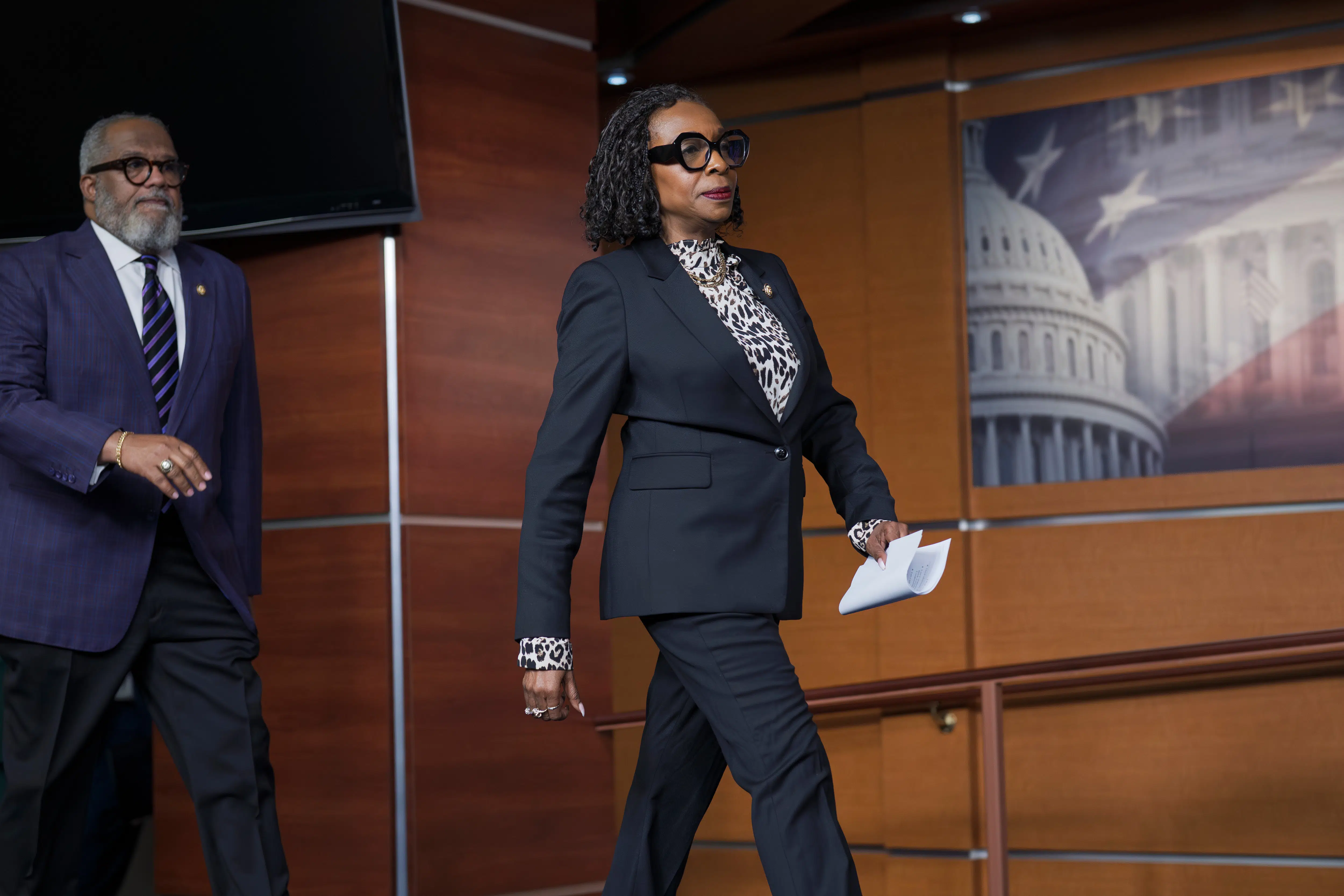

Black members of Congress are bracing for a crippling shake-up of their ranks after a Supreme Court ruling gutted a key section of the Voting Rights Act that had protected minority communities in political redistricting and helped boost their representation.
Wednesday's decision clears the way for Republican-led states to redraw U.S. House districts without regard to race, potentially creating many more GOP-friendly seats.
Recommended Videos
Rep. Yvette Clarke, chair of the Congressional Black Caucus, told reporters that its members and Democrats would fight the effects of the ruling.
“The Supreme Court has opened the door to a coordinated attack on Black voters across the country,” Clarke said. “This is an outright power grab.”
Under Section 2 of the Voting Rights Act, voters could challenge electoral maps that appeared to dilute the ability of minority communities to elect representatives of their choosing. The expected wave of congressional redistricting by Republican-controlled states after Wednesday's ruling, especially for the 2028 election and beyond, is likely to result in a much smaller Black Caucus.
Changes are coming, but how quickly is unknown
Clarke was joined by over a dozen of the 60 Black Caucus members, including Democratic House Minority Leader Hakeem Jeffries. Their responses to the court's decision ranged from outrage to defiance to mourning.
It's not clear how many seats will ultimately be affected by the ruling, but redistricting experts predict that more than a dozen now held by minorities could be swept away.
Rep. Troy Carter, one of two Black Democrats from Louisiana, the state at the center of the case, called the ruling “a devastating blow to our democracy, plain and simple.”
Republican leaders in several Southern states already have been discussing how to apply the ruling and create new GOP-friendly congressional maps. In Florida, Republicans wasted no time approving a new U.S. House map, part of which redrew one district created to elect a Black representative.
“I would be surprised if we do not see former slave-holding states moving at lightning speed to target districts that provide Black voters and other voters of color an equal opportunity to elect candidates,” said Kristen Clarke, general counsel for the NAACP and the first Black woman to be assistant attorney general in the U.S. Department of Justice's civil rights division.
It's not clear whether state-level voting laws or constitutional prohibitions against racial discrimination will provide any protection, she added.
Republican officials and Black conservatives praised the decision as a victory against race-based mandates. Linda Lee Tarver, of the Project 21 Black Leadership Network, said in a statement civil rights laws were not intended “to institutionalize racial line-drawing as a default feature of our political system.”
Voting Rights Act expanded Black representation
The Congressional Black Caucus was formed in 1971 as court-ordered redistricting under the Voting Rights Act, passed just six years earlier, sent more minorities to Congress.
The number of Black representatives in Congress jumped from nine to 13. Shirley Chisholm, the first Black woman elected to Congress, decided to expand the Democracy Select Committee created in the 1960s by Democratic Rep. Charles Diggs into the more formal Congressional Black Caucus.
The CBC raised its profile in its first year when it boycotted President Richard Nixon's State of the Union address after he refused to meet with the group. Nixon eventually acquiesced. The group created a list of over 60 recommendations to help the Black community, including counteracting racism and building adequate housing. It earned the nickname the “conscience of the Congress.”
“That caucus has had such an important voice in American politics — the things that we’ve been able to achieve together, the creation of equity and access," Democratic Sen. Raphael Warnock of Georgia said during a separate news conference Wednesday. “And I’m afraid that with this ruling, we could see that caucus shrink in a hugely significant way.”
What can Black constituents do
The ruling upset Thomas Johnson when he heard about it while visiting Louisiana's Capitol in Baton Rouge. Johnson, who is Black, is from New Orleans and represented by Carter. He fears Republicans could redraw the state’s congressional map in a way that dismantles predominately Black districts.
“I feel like this is an embarrassing attack upon the minorities, particularly the Black community,” Johnson said. “We have very little (voice) in Congress.”
Antjuan Seawright, a Democratic strategist who advises the Black Caucus, said he expects the group will be involved in multiple legal fights for members whose districts will be targeted after the Supreme Court ruling. He also said the ruling makes voter turnout efforts even more important "if we want to change course on some of the things that are likely to happen because of this decision.”
Democratic Rep. Terri Sewell of Alabama, whose state was at the center of a major Voting Rights Act case decided in favor of Black representation nearly three years ago, agreed that the party now needs to focus on getting voters motivated ahead of this year's midterm elections.
“Now more than ever, we need communities across this nation to mobilize — in state legislatures, in the courts and at the ballot box,” Sewell said. "We need to vote like we’ve never voted before." ___ Associated Press writers Leah Askarinam, Matt Brown and Ali Swenson in Washington and Sara Cline in Baton Rouge, Louisiana, contributed to this report.